

Malmö Art Museum Lunch Talk x Museum Why Afternoon Session
Minor Gestures & Speculative Tracing. Curator and researcher Anne Julie Arnfred and curator Anne Thomasen in conversation
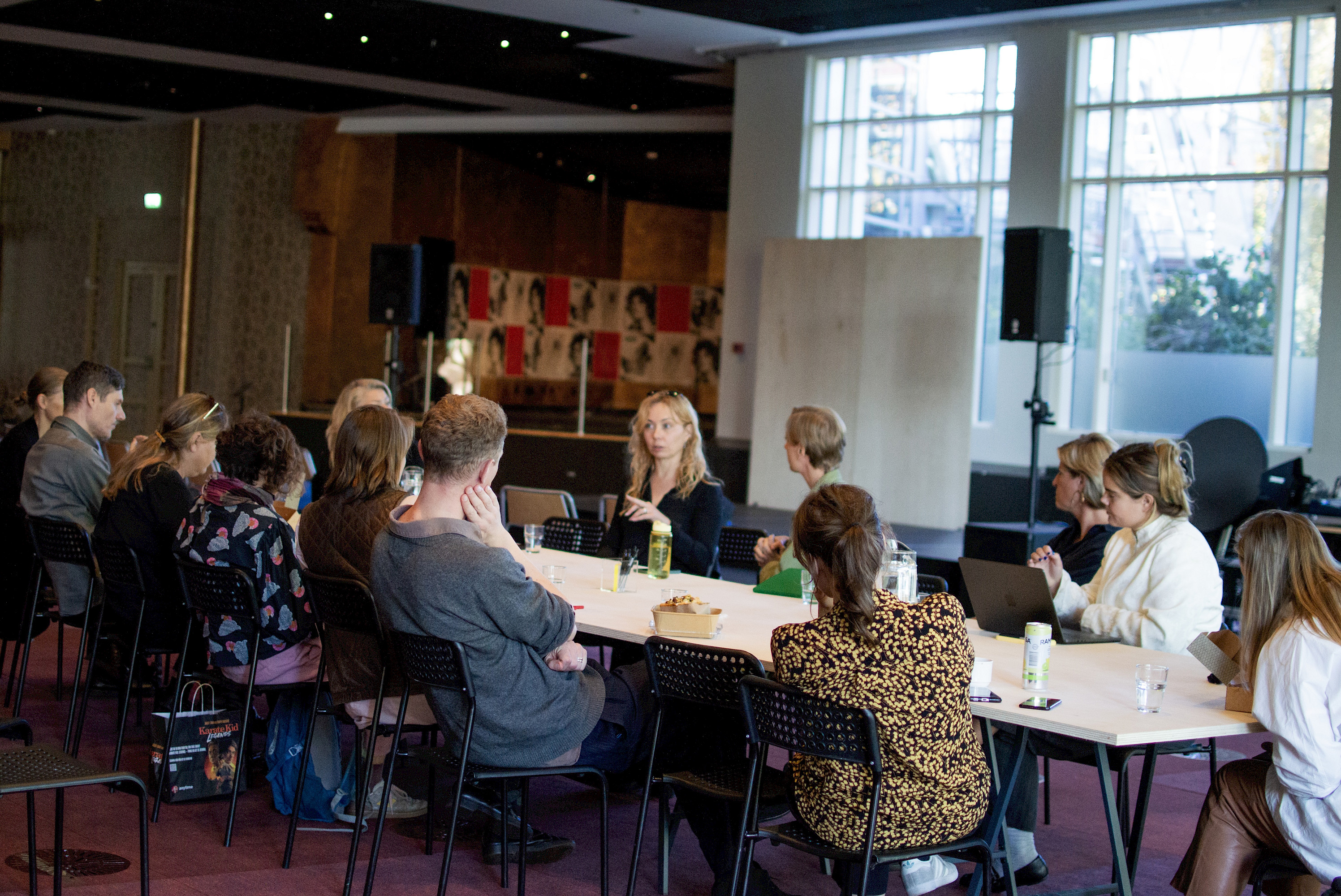
On 16 October 2025, the second Malmö Art Museum Lunch Talk of the autumn was held in Kungsparken this time merged with a Museum Why Afternoon Session. The conversation was led by curator Anne Thomasen, and featured curator and researcher Anne Julie Arnfred as a representative of Museum Why. The participants in the lunch talk, which was open to the public, represented a wide range of professional roles within museums, research, and architecture.
Anne Thomasen opened the conversation by presenting the Museum Why network as a collective institutional mobilization that through new collaborations explores how institutional structures can be reshaped. Since the networks founding in 2020, the partners have critically examined the changing role of art institutions in society and emphasized the need for stronger democratic values and greater local relevance. The collective work is directly motivated by the processes of change that the partner institutions are undergoing. Today, the network consists of PASS Center for Practice-based Art Studies (DK), Henie Onstad Kunstsenter (NO), PUBLICS (FI), EKKM (EE), Museet for Samtidskunst Roskilde (DK), and Malmö Konstmuseum (SE), which was also one of the institutions that initiated the network due to its upcoming relocation.
Over the past five years, Museum Why has collaborated through local symposia and artist residencies, and through these programmes one thing has become very clear: the network’s work is not simply about elevating conversations on change, but about translating change into practice - shaping how we program, organize, and think our institutions. This realization has generated a new direction for the network and its future programs, which will unfold through deeper partner collaborations, collective commissions and a series of publications. Through this there will be a focus on developing concrete methods for implementing the knowledge and ideas created by the network, drawing on both interdisciplinary and cross-professional perspectives.
Some of the questions that guide the direction of Museum Why today are: What role can art institutions play as active and critical forces in society? And how can these institutions reflect on their own practices and positions in order to transform themselves in line with what is necessary to both respond to and generate change?
Anne Julie Arnfred took over to describe her research and curatorial work with both exhibitions and workshop facilitation focused on temporary productions. She went on to speak about PASS (Novo Nordisk Center for Practice-based Art Studies), which, through study programs and a multiplicity of collaborations, both inside and outside the university, functions as a meeting point between the art world and the university - two fields where communication is not always straightforward. A central question in PASS´s work concerns how to create conditions for epistemic equity between practices and how to bring forward practice-based art studies movement between theory and practice. A recurring focus is turning the gaze inward and examining what an organization and singular practices does that is not always visible to others.
The conversation continued with a discussion of what an exhibition does and which actions constitute it. Anne Julie raised questions about the significance of space. How do physical conditions, minor gestures such as temperature or furnishing, affect the experience of a study space or exhibition? These aspects are tested in practice through an ongoing critical approach. The concept of speculative tracing was described as a method that directs attention to how something comes into being, rather than to a finished result.
Anne Julie posed the question: How might one include practices from feminist theory, process philosophy and the notion of the curatorial in a more concrete way? She suggested that it involves seeing the curator as a facilitator. Exhibitions should be understood as collective processes of creation, and much of the work takes place outside the exhibition space. It is about creating environments within organizations where people feel seen and safe, and where there is room for experimentation, uncertainty, and multiple perspectives.
She emphasized that the working process for Museum Why is not predefined but shaped in relation to the situation. Social and spatial factors, such as how conversations are distributed or how a room is experienced, thus become an active part of the work. Anne Julie stated: “It’s not only about creating harmony, but also of disrupting that harmony (if it is to dominate), disrupting the smooth surface by bringing in questions that can create a bit of friction - that can also create something.” She also described how collaborations often include actors outside the art world and how local experiences and knowledge can be given space to reach new audiences.
When documentation and production formats were discussed, Anne Julie stressed that she avoids video, sound, and images, as they can disrupt intimacy. Instead, she works with field notes, memory writing and written testimonies that are followed up over time. In one project, for example, differing views on the form of the material led to reflections on methodological choices, a conversation-based exhibition, and later a new research project.
Finally, Museum Why was discussed in relation to institutional change and how knowledge can be developed in more situation- and site-specific ways. Anne Julie emphasized the importance of continuing to ask what a museum is and which narratives are being produced. Differences between actors were highlighted as a strength, where conversations between institutions with different positions can create new ways of thinking.